
Romeo Follow-Up Requires Written Proof
Get every step in writing. After an appearance, motion, bond, or permitted payment in Romeo, ask for the resulting court order or register entry and read it closely. Confirm the case number, the action date, the next setting, and whether the warrant was recalled, quashed, served, or still stands as active. Ask whether a serving agency gets separate notice, and when that update should appear. If an older status lingers, use the dated document to ask the responsible clerk for a correction. Delay does not create a new ruling, and originals should never be surrendered to an unverified contact.
Romeo Population Gives Limited Context
Romeo counted 302 people in the 2020 Census, fifth among the county's incorporated towns. That figure is context, nothing more. It says nothing about warrant volume, crime, court compliance, or any one person's risk, and no Romeo warrant-caseload dataset exists to check. Small size does not mean records sit in one central online place either. Romeo residents can have state cases outside municipal court, while a municipal citation can name a nonresident. Pull the issuing court from the paperwork itself. Population and residence settle nothing about where a Romeo warrant lives.
Checking for a Warrant in Romeo
Start with the original paper, because Romeo has no public warrant search screen to consult. Copy the court name, the issuing agency, the citation or case number, the date, the alleged violation, and the required appearance. That court label tells you whether the case is a local ordinance matter or a state traffic or criminal filing.
- Read the court and agency exactly as printed on your own citation, summons, or notice.
- Use the stated court contact and verify that it currently handles Romeo municipal cases.
- If the paper identifies a Colorado county or district case, search the state docket as an index and contact Conejos Combined Court.
- Ask the issuing clerk whether a warrant or failure-to-appear event is current and what document records it.
- If confirmed, obtain lawful appearance, counsel, motion, bond, payment, or surrender instructions before traveling.
Silence online proves nothing in Romeo. A local case may sit outside the state docket, and sealed, juvenile, new, or restricted records may not display at all.
Romeo Official-Page Gap Is Material
The state-hosted Romeo town page does not load. The town currently publishes no official address, court telephone, clerk name, session date, payment portal, warrant procedure, fee, or turnaround for verification. Filling those gaps with commercial directory data would breed false confidence and could send you to the wrong office in person.
Verification required: Use the current contact printed on the citation and confirm that office’s identity before disclosing personal information or sending payment.
A dead page is not a finding about the town. Romeo still has a court, police service, and warrants; the missing piece is only a town-specific public web channel. Write down the date and method of each contact you make, so later steps can be checked against a reliable source.
Romeo Police and Municipal Court
The Colorado Municipal Courts Association directory places Romeo in the municipal-court context, but a directory entry is not the town court's warrant database. A municipal judge controls a local warrant order. A clerk keeps the court file, and a serving law-enforcement agency holds enforcement records. Those functions may not share one office or system.
Romeo Municipal Court Route
Begin with the official contact on the citation
Current schedule and location not verified
State-Case Fallback
Conejos Combined Court
719-376-5465
ConejosClerk@judicial.state.co.us
Use the state-court contact only for state-filed matters. It cannot replace the Romeo municipal clerk on a town ordinance case.
Directory Entry Is Not a Romeo Warrant List
The Colorado Municipal Courts Association directory is a neutral way to confirm municipal-court context for Romeo. It shows no warrant status, no search fields, no people or case rows, no recall dates, and no completeness terms. Treat it as a pointer, not a warrant list.
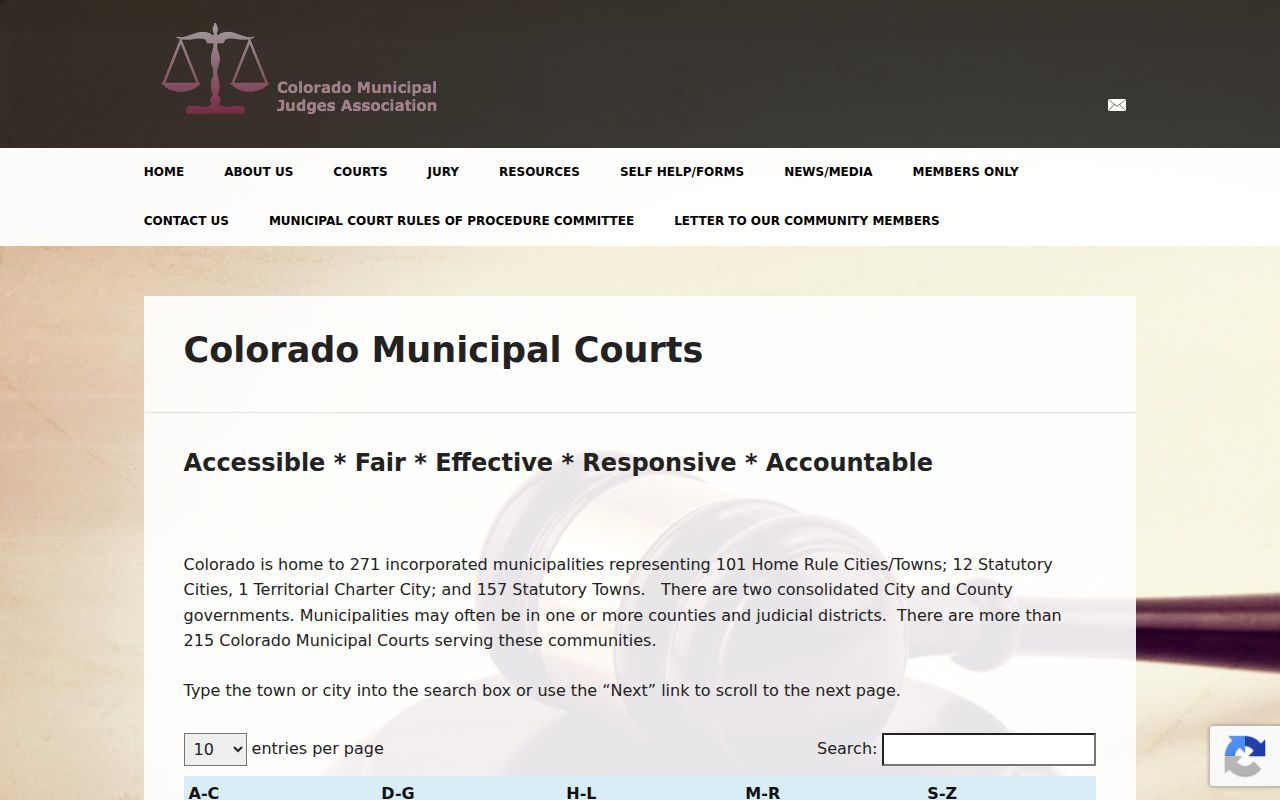
Use the directory entry to locate or verify a court channel. Then ask that court about your own case. Never turn an institutional listing into a claim that a particular person is wanted in Romeo, and never assume the association keeps the underlying official court record itself.
Romeo Warrant Types
The likely warrant types follow Colorado court structure, but Romeo publishes no roster or terminology guide of its own. Tie every status to the issuing court.
| Type | Possible origin | Verification route |
|---|---|---|
| Municipal bench warrant | Missed required response in a Romeo ordinance case | Municipal court named on citation |
| Municipal traffic matter | Town-issued ticket | Issuing municipal court |
| State bench warrant | Missed duty in county or district court | Conejos Combined Court |
| Arrest warrant | A judge directs arrest in a criminal case | Issuing court |
| Search warrant | A judge authorizes a search or seizure | Issuing court, subject to disclosure limits |
A missed date can lead to further action, but a citation alone does not prove a warrant exists. Ask the Romeo court for current confirmation.
Inside a Romeo Warrant Record
Romeo posts no public result rows, so a blank schema shows what an own-record inquiry needs without inventing a case. Use citation number from the Romeo notice rather than any real identifier. The layout is a guide, not a record.
| Issuing agency | Helps distinguish municipal from state enforcement |
|---|---|
| Court named | Identifies the likely custodian |
| Citation or case number | Locates the requester’s file |
| Violation and date | Describes the allegation and timing, not guilt |
| Appearance date | Shows the required response stated on the paper |
| Current court event | May reflect FTA, warrant, recall, or a new setting when confirmed |
Never publish a name, birth date, license number, plate, address, photograph, or narrative. Give sensitive identifiers to Romeo officials only through a verified channel.
No Verified Romeo Payment Process
Romeo currently offers no official payment page, accepted method, mailing address, payee, payment-plan procedure, warrant fee, or recall process to verify. A neighboring town's online vendor or schedule cannot be borrowed for Romeo instructions. Municipal courts are separate custodians with different practices.
- Confirm the court from the citation before paying.
- Ask whether payment is permitted when a date was missed.
- Verify the amount, payee, method, and official receipt channel.
- Ask whether appearance, motion, bond, or counsel is also required.
- Request dated proof of any recall or new setting.
A zero balance does not necessarily mean a Romeo warrant was withdrawn. Likewise, a payment demand from an unsolicited caller does not prove a case exists.
Romeo Warrant Search Has No Public Interface
Romeo offers no public lookup of its own. The town publishes no name-search form, no active-warrant list, and no warrant-number field or status filter, and nothing runs on a stated update schedule. No countywide municipal roster stands in as a Romeo warrant search either. Silence here proves nothing about whether warrants exist. A commercial "Romeo warrants" page is a separate hazard. It can stitch together stale arrest, docket, and address data, and it can mistake one person for another. It also cannot show that the issuing judge later recalled an order. Treat such a result only as a lead for your own matter or a family member's, and resolve it through an authorized official channel rather than to accuse, screen, or confront anyone.
How Romeo Warrants Fit the County System
Match the paper to its court. A Romeo ordinance case stays with the municipal court named on the citation. Colorado state cases go elsewhere. Misdemeanors, felonies, petty offenses, and state traffic matters route to Conejos Combined Court, while sheriff records may involve service, custody, or law enforcement. The Conejos County warrant records overview maps those county routes without passing them off as Romeo's local procedure.
Warrant flow: Romeo municipal citation and court → serving agency when judicially ordered → state law-enforcement systems that are not one public warrant search.
Which agency actually serves a Romeo order is not settled, so treat this flow as a sketch. Ask the issuing court directly who receives its warrant.
State Court Only for State-Filed Romeo Matters
Start with the court named on the paper. Papers citing Conejos County Court or District Court put a Romeo case in state court, where the Colorado Judicial Branch docket can locate a public record by county, court, case number, or your own name. The docket is not a warrant database. It has no warrant-status checkbox. For Romeo matters, a docket may list hearings yet say nothing about whether a warrant stands today. Conejos Combined Court customer service and proceedings moved temporarily after the courthouse fire to 603 Main Street in Antonito. Hours run Monday through Friday, 8:00 a.m. to 4:00 p.m., excluding state holidays, though trials may have a different location on the summons. Call 719-376-5465 before traveling. That county facility is not Romeo Municipal Court.
Romeo Warrant Records and Public Access
Colorado guards these records with layered rules. Even a Romeo docket entry can omit or misstate facts. The Judicial Branch Access Guide says the original court should confirm what you find, and sealed, juvenile, suppressed, protected, confidential, or investigative material may be withheld or redacted.
Key rules:
Colorado Criminal Justice Records Act, C.R.S. §24-72-301 et seq. governs records held by criminal-justice custodians.
CJD 05-01 and PAIRR policy govern access to Colorado court records.
C.R.S. §19-1-304 and related juvenile provisions restrict juvenile information.
Your own request cannot break a seal. If Romeo access is denied, ask for the legal basis, the correct custodian, and the review route.
Romeo Own-Record Contact Log
Romeo offers no web route here. A careful contact log fills that gap, so keep factual notes for each call rather than trusting memory.
- Date, time, telephone or web address used
- Office and role of the responder
- Your own citation or case number
- Whether the office confirmed it is the custodian
- Status date and exact next instruction
- Current location, session date, documents, and payment method if verified
- When any serving agency should receive an update
Skip unnecessary personal identifiers in your notes. If staff refer you on, note the reason. Repeated referrals can mean the original Romeo paperwork was read wrong, though they do not by themselves prove the case is clear.
Resolve a Romeo Warrant Carefully
Only the issuing court can quash or recall it. No other office holds that power. Once the right Romeo municipal court is confirmed, ask what the lawful next step is: an appearance, a new date, a motion, counsel, bond, permitted payment, or surrender. No universal Romeo warrant fee exists. There is no automatic online recall. The town runs no amnesty day and promises no guaranteed processing period. Where custody is possible, identity is unclear, or probation or another jurisdiction overlaps, a lawyer can shape the response. Keep every receipt, order, and clerk confirmation, and ask whether the serving agency gets separate notice or another case stays open.
Safety: Never pay cryptocurrency, gift cards, prepaid cards, or a rushed transfer to an unsolicited caller claiming to clear a Romeo warrant.
Romeo Warrant Status Must Be Current
Warrants move through stages: issued, active, served, recalled, quashed. An old issue date proves nothing. A payment record does not prove recall, and closure cannot be inferred from a stale Romeo docket row.
- Failure to appear
- A missed required response that may prompt further court action.
- Bench warrant
- A judge’s arrest order, often linked to a missed duty.
- Recall or quash
- Later court action withdrawing or cancelling the order.
- Service return
- A law-enforcement record concerning execution, separate from the judicial order.
Ask for proof in writing. Request status as of your Romeo contact date plus the next required act. If another system later shows old data, ask the court which custodian controls correction.